


- Sulfuric Acid Flow Meter Selection Guide (Part 2)
【【Review of Last Episode】Last week, we published "Sulfuric Acid Flow Meter Selection Guide (Part 1)", which provided detailed explanations of the working principles and respective advantages and disadvantages of electromagnetic, mass, ultrasonic and orifice plate flow meters. (Those who haven't read it can click here to jump to review"The Previous Link".)
This issue serves as the sequel. We will now move on to the most "rigorous" practical section. From the drying cycle acid to the high-temperature waste heat recovery system, we will analyze the operating conditions of each measurement point one by one, confront the "difficulties and complications" in sulfuric acid flow measurement, and present the final selection comparison table to assist you.
∣. Working conditions of the sulfuric acid measurement points in the sulfuric acid production facility
The main measurement points for sulfuric acid flow in the sulfuric acid production process include the drying circulating acid, the second absorption circulating acid, the finished acid, loading, waste heat recovery circulating acid, and other related sections. The physical properties, process parameters and measurement requirements of each measurement point are different, and specific selection of flow meters is required for each case.
1. Drying cycle acid
The drying cycle acid is concentrated sulfuric acid used in the drying towers of the sulfuric acid plant to dry air. Typical operating parameters are as follows: sulfuric acid concentration 93% - 98%, temperature 60℃ - 85℃, pipe diameter DN80 - DN500, working pressure 0.1 - 0.3 MPa, flow rate range 20 - 1500 m³/h.
The electrical conductivity of the dry cycle acid is relatively high, making it suitable for measurement by electromagnetic flowmeters. However, it is necessary to pay attention to the influence of changes in sulfuric acid concentration on the electrical conductivity, as well as the wear of the liner by the possible trace solid impurities in the circulating acid. It is recommended to use electromagnetic flowmeters with PTFE or PFA liners and platinum-iridium electrodes, with a protection level of no less than IP65.
2. Second-stage Absorption Acid
The two-stage absorption acid is the circulating acid used in the second absorption tower to absorb sulfur trioxide to produce sulfuric acid. Typical conditions: sulfuric acid concentration 98% - 99%, temperature 70℃ - 90℃, pipe diameter DN100 - DN600, working pressure 0.1 - 0.3 MPa, flow rate range 30 - 2000 m³/h.
The concentration of the two-stage absorption acid is high and its conductivity is good, making it an ideal application scenario for electromagnetic flowmeters. Due to the extremely strong corrosiveness of 98% sulfuric acid, the selection of the flowmeter's liner and electrode materials is particularly crucial. It is recommended to use an electromagnetic flowmeter with PFA liner and tantalum electrodes to ensure long-term stable operation.
3. Finished acid flowmeter
The finished acid flowmeter is used to measure the output of finished sulfuric acid from the production unit, and it is an important basis for production statistics and trade settlement. Typical operating conditions: sulfuric acid concentration of 93% or 98% (depending on product specifications), temperature ranging from 30℃ to 40℃, pipe diameter from DN50 to DN100, working pressure from 0.2 to 0.5 MPa, flow range from 10 to 200 t/h.
The measurement of the finished acid requires high precision. A mass flowmeter (with an accuracy of ±0.2%) is selected to achieve direct mass measurement and avoid errors caused by changes in density.
4. Loading flowmeter
The flowmeter is used for trade measurement during the loading (ship unloading) process of the finished acid. Typical conditions: sulfuric acid concentration of 93% or 98%, at room temperature, pipe diameter ranging from DN80 to DN150, working pressure of 0.3 to 0.6 MPa, single loading volume of 30 to 50 tons, flow range of 20 to 300 t/h.
The loading measurement is conducted in trade settlement scenarios and requires the highest level of accuracy. Therefore, a mass flowmeter must be selected. The mass flowmeter can directly measure the mass flow rate and is not affected by changes in temperature and density. The accuracy can reach ±0.1% to ±0.2%, meeting the regulatory requirements for trade measurement. At the same time, a batch control function should be equipped to achieve quantitative loading.
5. Waste heat recovery recycled acid
The waste heat recovery system (HRS) is an energy-saving device in the sulfuric acid plant that utilizes the high-temperature waste heat to generate steam. The measurement of sulfuric acid flow is crucial for the optimization control of the system. The typical operating conditions are shown in the following table:
.jpg)
The temperature of the first-stage acid in the waste heat recovery system is high (ranging from 180℃ to 220℃) and the concentration is high (≥99%). This imposes extremely high requirements on the material of the flowmeter for its temperature resistance and corrosion resistance. The lining material of the electromagnetic flowmeter is limited at this temperature, so ceramic lining or special high-temperature electromagnetic flowmeters need to be selected. The ultrasonic flowmeter has certain advantages in high-temperature and high-concentration environments because it does not directly contact the medium.
6. Waste heat recovery acid production and secondary acid flowmeter
The waste heat recovery acid production flowmeter is used to measure the output of the finished acid from the HRS system, with a temperature range of approximately 60℃ to 80℃ and a concentration of 98% to 99%. The secondary acid flowmeter of the waste heat recovery system is used to measure the circulating acid in the second-stage heat exchanger of the HRS system, with a temperature range of 120℃ to 160℃ and a concentration of 98% to 99%.
The flowmeter for acid production from waste heat recovery can use conventional electromagnetic flowmeters (with PFA lining and tantalum electrodes). For the secondary acid flowmeter in waste heat recovery, since the temperature is high, a high-temperature-resistant electromagnetic flowmeter or ultrasonic flowmeter should be selected. When making the selection, it is necessary to fully consider the impact of acid temperature on the aging of the lining material and the corrosion rate of the electrodes, and appropriately increase the material grade.
II. Problems in Sulfuric Acid Flow Measurement
During the actual operation of the sulfuric acid plant, the flow measurement system often encounters various problems, which affect the accuracy and reliability of the measurement. The common problems and their causes are as follows:
1. Displays inconsistency with DCS
The inconsistency between the local display of the flowmeter and the display value of the DCS system is a common problem. The main reasons include: poor contact or electromagnetic interference in the signal transmission lines; inconsistent range settings of the DCS system with the flowmeter; mismatch between the output signal type (4-20mA or pulse) of the flowmeter and the input card of the DCS; incorrect settings of the range upper and lower limits, squaring/linearization in the DCS configuration. When dealing with this issue, one should check the signal lines one by one, review the parameter settings, and if necessary, perform signal calibration.
2. Measure flow fluctuations
The flow display value fluctuates frequently. Possible causes include: bubbles or two-phase flow in the pipeline; poor grounding of the electromagnetic flowmeter, subject to external electromagnetic interference; improper installation position of the transducer in the ultrasonic flowmeter or failure of the coupling agent; vibration of the pipeline transmitting to the flowmeter sensor; pulsation of the fluid itself (such as at the outlet of a reciprocating pump). The handling methods include: improving process conditions to eliminate bubbles; checking the grounding resistance (it should be less than 10Ω); reinstalling the transducer; adding vibration reduction measures; increasing damping time, etc.
3. The measured flow rate is too low
The display value of the flowmeter is significantly lower than the actual flow rate. Possible causes include: fouling on the inner wall of the electromagnetic flowmeter sensor, resulting in a reduction in the flow passage area; contamination or corrosion of the electrodes of the electromagnetic flowmeter, causing a weakened signal; wear of the orifice plate in the orifice plate flowmeter, with an increased opening diameter; fouling or aging of the transducer in the ultrasonic flowmeter, causing signal attenuation; incorrect setting of the flowmeter parameters (such as a too small pipe diameter setting). Regular checks and cleanings of the sensors, calibration of the electrodes, inspection of the orifice plate wear, and rechecking of the instrument parameters should be conducted.
4. The measured flow rate is too high
The display value of the flowmeter is significantly higher than the actual flow rate. Possible causes include: interference from high-power electrical equipment near the electromagnetic flowmeter; zero drift of the flowmeter, resulting in an overestimation of small flow rates; blockage or leakage of the negative pressure intake pipe of the orifice plate flowmeter; incorrect parameter settings of the ultrasonic flowmeter (such as setting the pipe wall thickness too small); the presence of a large number of bubbles in the fluid, causing the measured value to be higher. Interference sources should be identified, the zero point should be reset, the intake pipeline should be inspected, and the instrument parameters should be verified.
5. Sulfuric acid leakage
Leakage of the sulfuric acid flowmeter and its connection parts poses a serious safety hazard. Common leakage points include: aging or improper selection of the flange sealing gasket; corrosion and perforation of the sensor housing; failure of the sealing of the junction box; cracking of the pipeline weld. Preventive measures include: selecting sealing gaskets resistant to sulfuric acid corrosion (such as PTFE-coated gaskets, flexible graphite gaskets); regular inspection of the corrosion condition of the sensor; ensuring that the electrical interface meets the protection grade standard (at least IP65); installing leakage detection devices. If leakage is detected, it should be dealt with immediately, and personal protection should be taken.
6. Sensor corrosion
The strong corrosiveness of sulfuric acid is the greatest challenge faced by flowmeter sensors. Corrosion can occur in various parts such as the lining, electrodes, and measurement tubes. Common corrosion problems include: improper selection of lining material leading to penetrating corrosion; electrodes not being resistant to corrosion resulting in signal attenuation; and an accelerated corrosion rate under high-temperature and high-concentration conditions. Countermeasures include: selecting corrosion-resistant materials based on the concentration and temperature of sulfuric acid and conducting regular inspections of the inner wall of the sensor; appropriately shortening the maintenance cycle in extreme corrosive conditions; and considering the use of non-contact measurement schemes such as ultrasonic flowmeters.
III. Flow Meter Selection Recommendation
Based on the operational characteristics of each measurement point and the applicability analysis of the flow meters, taking into account factors such as measurement accuracy, reliability and economy, the following selection recommendation scheme is proposed:
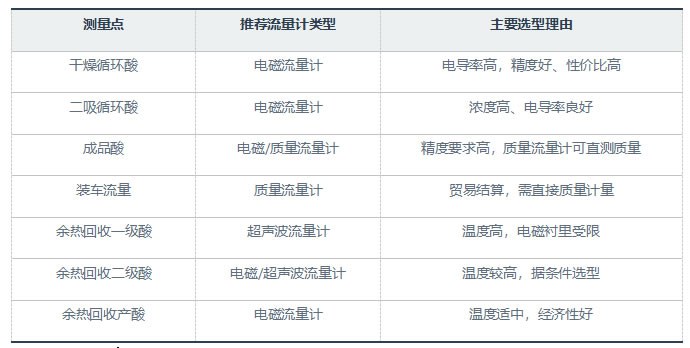
1. Selection Explanation: Key points for selecting electromagnetic flowmeters: The recommended lining materials are PFA or ceramics (for high-temperature applications), and the electrode materials are tantalum or platinum-iridium alloy. The protection level should be no less than IP65, and the junction box should be made of corrosion-resistant material. For circulating acids containing solid particles, a wear-resistant lining should be selected.
2. Key points for selecting ultrasonic flowmeters: It is recommended to choose multi-channel models to enhance measurement accuracy. The transducer material should be resistant to sulfuric acid corrosion, and during installation, ensure good coupling with the pipe wall. They are suitable for high-temperature and high-concentration environments where electromagnetic flowmeters are not competent.
3. Key points for selecting quality flow meters: It is recommended to choose U-shaped tube or micro-bent tube designs. The material of the measuring tube should be Hastelloy C or tantalum. In installation scenarios, a batch control function should be provided as a complement. During installation, vibration interference should be avoided and proper support and fixation should be ensured.
4. General Precautions: The material of all the liquid-contact components of the flow meters must match the concentration and temperature of the sulfuric acid; the installation location should avoid strong electromagnetic interference sources and strong vibration sources; sufficient straight pipe sections should be reserved (5D before and 3D after for electromagnetic flow meters, 10D before and 5D after for orifice plate flow meters); regular calibration is the key to ensuring long-term measurement accuracy.
The above selection recommendations serve as general technical guidelines. When making the final selection, it is necessary to conduct a comprehensive assessment by taking into account the actual operating conditions of the equipment, process requirements, and user preferences. It is recommended to consult the professional technicians of the flowmeter manufacturer before making the final selection to obtain detailed technical solutions tailored for specific applications.
At this point, both parts of the "Sulfuric Acid Flow Meter Selection Guide" have been fully shared. We hope this detailed guide can provide practical references for your instrument selection and maintenance work.